
Speed is not structure.
Fast-moving fashion creates a search infrastructure challenge. Products sell out, URLs disappear, seasonal ranges change and regional catalogues shift, but product meaning and search value should not vanish with the SKU.
A product can sell out. The search entity should not.
Zara, H&M and Uniqlo are useful benchmark examples because they represent different fashion retail models: trend-led and visual, range-led and marketplace-like, and product-system-led.
The point is not to claim that one brand wins or fails in AI search. The point is to show the infrastructure challenge that every fast-moving retailer faces: what happens to product meaning, category value and search demand when individual products disappear?
Search Growth Infrastructure should preserve product value after a product sells out and route demand towards the next best page.
This is not a ranking. It is a structural benchmark.
This benchmark uses Zara, H&M and Uniqlo as public reference points for three different fashion retail models: trend-led and visual, range-led and marketplace-like, and product-system-led.
It is not a ranking of the brands. It does not claim to measure their internal systems, rankings, AI visibility, redirect rules, stock handling or commercial performance.
Instead, it uses these models to explain a wider search infrastructure problem in fast-moving ecommerce: how can product meaning, category value and user demand survive when individual products sell out, move, change or disappear?
The question is whether the website has a structure that preserves the value behind that product over time.
Fast fashion creates a product memory problem.
Fast fashion is built around speed. New collections appear quickly, products change constantly, styles sell out, seasonal pages move on and regional stores may show different ranges, prices and stock.
That makes sense commercially. But in the AI search era, speed creates a structural problem. Search systems and AI assistants do not only need to see what is available today. They need to understand what the product is, how it relates to a wider category, whether it replaces or updates a previous item, and where its authority should go when the product disappears.
If a product URL simply disappears, the site risks losing accumulated relevance, links, behavioural signals and category context.
The product is gone, but the demand remains.
Three models. Three different preservation challenges.
Zara-style: speed and visual change
The challenge is not only launching new products quickly. It is preserving product meaning when trend-led items move through the catalogue quickly and may not return in the same form.
H&M-style: range depth and variation
The challenge is keeping broad ranges, variants, regional stock, category logic and product attributes coherent enough for users, search engines and AI systems to understand.
Uniqlo-style: recurring product systems
The challenge is using recurring product families, basics and functional apparel concepts as durable entities, while keeping global and local execution aligned.
What a fashion retail benchmark should look for.
A useful fashion retail benchmark should look beyond individual product pages and examine the signals that help product meaning survive over time.
| Benchmark signal | Why it matters | Zara-style model | H&M-style model | Uniqlo-style model | What good looks like |
|---|---|---|---|---|---|
| Product URL permanence | Tests whether search value survives product churn. | Higher risk where trend-led seasonal items rotate quickly. | High complexity because of large ranges and frequent variants. | Potentially stronger where product families recur over time. | Retired products are redirected, archived or routed to the closest useful successor, not left as dead ends. |
| Category depth | Shows whether demand is preserved beyond the live SKU. | Visual merchandising and collection pages carry much of the meaning. | Broad categories need strong filtering, hierarchy and product grouping. | Product families can support durable category and collection logic. | Category and collection pages remain useful even when individual products change. |
| Product attribute consistency | Helps products be compared, filtered and understood. | Style, cut, colour, collection and occasion signals need consistency. | Material, size, colour, sustainability and variant data can become fragmented. | Functional attributes can be clearer where product systems are repeatable. | Colour, material, fit, length, season, occasion and style are consistently exposed. |
| Successor routing | Determines where value goes when a product expires. | Critical for seasonal and trend-led demand. | Critical across broad ranges, variants and regional catalogues. | Useful where recurring basics are updated or replaced. | Every expired product has a clear next-best route: replacement product, durable category, product family or archive page. |
| Archive or redirect logic | Prevents expired products becoming invisible or wasteful. | Important where trend items receive social or press attention. | Important where catalogue scale creates many expired URLs. | Important where legacy product families hold search value. | High-demand expired products are preserved or archived; low-value expired products are redirected sensibly. |
| Global/local alignment | Tests whether regional execution fragments product truth. | Local ranges and country sites can split product meaning. | Marketplace-like breadth can increase duplication and localisation issues. | Global product concepts may create stronger alignment, but local execution still matters. | Local pages support one coherent product entity rather than creating disconnected versions of the same idea. |
The issue is one product truth with localised execution.
A fast-moving global retailer may have seasonal product turnover, regional inventory variation, localised URLs, product variants, collection pages, category pages and country-specific ecommerce experiences.
The infrastructure challenge is to stop those localised execution layers from fragmenting the underlying product truth.
A product should belong clearly to categories, materials, colours, styles, occasions, collections, successor products and evergreen demand pathways. When one SKU expires, the system should know where the value goes next.
The 404 Ghost Problem.
The 404 Ghost Problem occurs when a product page disappears but the search demand for that product does not.
A product may be removed from sale, but the user intent, category meaning, backlinks, social attention and behavioural signals attached to that product may still have value.
When the URL becomes a dead end, that value is wasted.
Search Growth Infrastructure should give that demand somewhere useful to go: a successor product, a durable category, a product family, a material or colour collection, or an archive page where the product has enough ongoing demand to justify preservation.
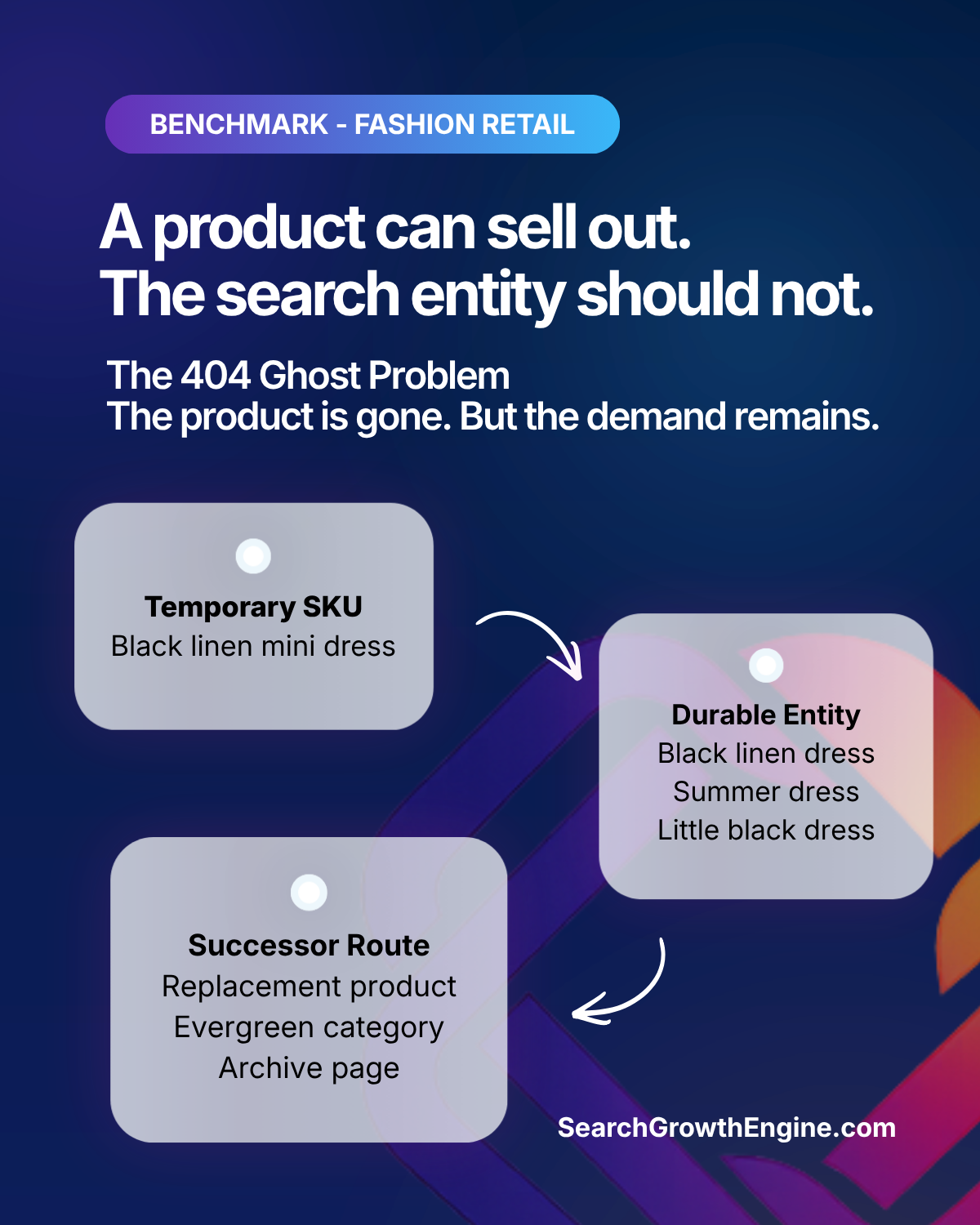
A fast-fashion black linen mini dress should have an exit plan.
The 404 Ghost Problem is easiest to understand through a specific product.
Imagine a fast-fashion black linen mini dress. It may appear in a seasonal collection, get indexed, receive links or social attention, collect behavioural signals, rank for specific terms, then sell out.
From a retail operations point of view, the product may be finished. From a search infrastructure point of view, the value is not finished.
Temporary SKU
The exact seasonal product: for example, a black linen mini dress in a specific collection, size range and region.
Durable product entity
The reusable idea behind the product: black linen dress, summer dress, little black dress, holiday dress or capsule wardrobe basic.
Successor route
The replacement product, closest category or evergreen collection that should inherit the user intent and search value.
The product can disappear from sale, but the product knowledge should not disappear from the search system.
Sold-out products should route value, not create dead ends.
When a product is temporarily sold out, the page can remain live with an honest unavailable message, clear alternatives and structured availability information.
When a product is permanently retired, the site should decide whether to redirect to the closest successor product, redirect to a durable category or preserve an archive page if the product has strong search demand, backlinks, press or social attention.
The guiding question is simple: where should this product’s search value go now?
Every fast-moving product needs a preservation rule.
Still in stock
Keep the live product page focused on ecommerce intent, while exposing clear product attributes and related categories.
Low or temporarily out of stock
Keep the page useful with availability clarity, similar styles, related materials, colour pathways and category links.
Retired with a close replacement
Redirect or route users to the successor product where the intent and product match are genuinely close.
Retired without a replacement
Redirect to a durable category, product family, colour/material collection or style page that best preserves the intent.
High-demand expired product
Keep an archive page if the item has meaningful backlinks, press, influencer attention or ongoing search demand.
Low-value expired product
Redirect to the closest relevant category rather than leaving a dead page or sending users to the homepage.
Expired products should not simply cease to exist.
For search systems and AI assistants, an expired product should not simply look as though it has ceased to exist. Where possible, the site should make the relationship clear: this product belonged to this category, carried these attributes, served this intent, and now routes to this successor, archive or evergreen collection.
That is how product meaning is preserved rather than lost. The product may leave the catalogue, but its search value can still strengthen the next best page.
The commercial lesson applies beyond big retailers.
This benchmark is not only about large fashion brands. The practical lesson is highly relevant to smaller ecommerce retailers.
A small fashion brand may not need enterprise infrastructure, but it does need durable collection pages, standardised product attributes, sensible redirects and a simple successor rule for seasonal products.
Without that model, the pattern is: launch product, generate demand, sell out, delete product, lose search value and start again. With Search Growth Infrastructure, the pattern becomes: launch product, attach it to a durable entity, capture demand, route expired value and strengthen evergreen categories.
When a product sells out, does the page strengthen the next best destination, or does the value disappear?
The structure behind fashion retail search growth.
Product entity clarity
Whether products belong to durable concepts, categories, styles, materials and occasions beyond the live SKU.
Collection architecture
Whether categories and collections preserve recurring demand when individual products change or expire.
Regional sitemap logic
Whether localised versions support one coherent product truth rather than fragmenting authority.
Structured attributes
Whether colour, material, fit, length, season, occasion and style information is consistent enough to support discovery.
Successor mapping
Whether expired products have a clear route to replacement products, categories or archive pages.
Comparison readiness
Whether product data is easy for users, search engines and assistants to compare, filter and reuse.
Fast catalogues need compounding search systems.
Fashion retail will always move quickly. Products will launch, sell out and change. But the search value behind those products should not disappear every season.
Search Growth Infrastructure helps retailers preserve product meaning, route expired demand and strengthen durable categories over time.
SearchGrowthAI turns this kind of structural diagnosis into a clear assessment of whether a retailer’s current setup is protecting product value or quietly leaking it.
Make every expired product strengthen the next best page.
Explore connected benchmark themes.
Fashion retail connects to digital scale, product data governance and practical ecommerce guides.
Scale is not search infrastructure
How large content and product ecosystems still need clear governance and entity structure.
Practical guides for ecommerce retailers
Turn benchmark ideas into useful actions for product, collection and seasonal search growth.
The Search Growth Infrastructure Thesis
Why modern search visibility depends on structured, connected and machine-readable information.
This benchmark is a hypothesis-led structural analysis for editorial, educational and strategic discussion. It does not make claims about Zara, H&M, Uniqlo or any other retailer’s rankings, stock, internal systems, product performance, AI visibility, sustainability, sourcing or commercial results.
Any third-party brands, company names, trademarks or platform references mentioned remain the property of their respective owners. References are used solely to discuss publicly visible ecommerce structure, product information architecture and search growth patterns.
SearchGrowthEngine and SearchGrowthAI are not affiliated with, endorsed by, or officially connected to the organisations referenced unless explicitly stated otherwise.
Are your products, categories and expired URLs leaking search value?
The SearchGrowthAI assessment helps identify whether your ecommerce structure, internal links, product data and category pathways are working as a connected growth system.